

Why Every School Should Offer Psychometric Tests for Career Guidance
August 27, 2026
Mental Health Training in Schools: Impact on Student Academic Performance
August 31, 2026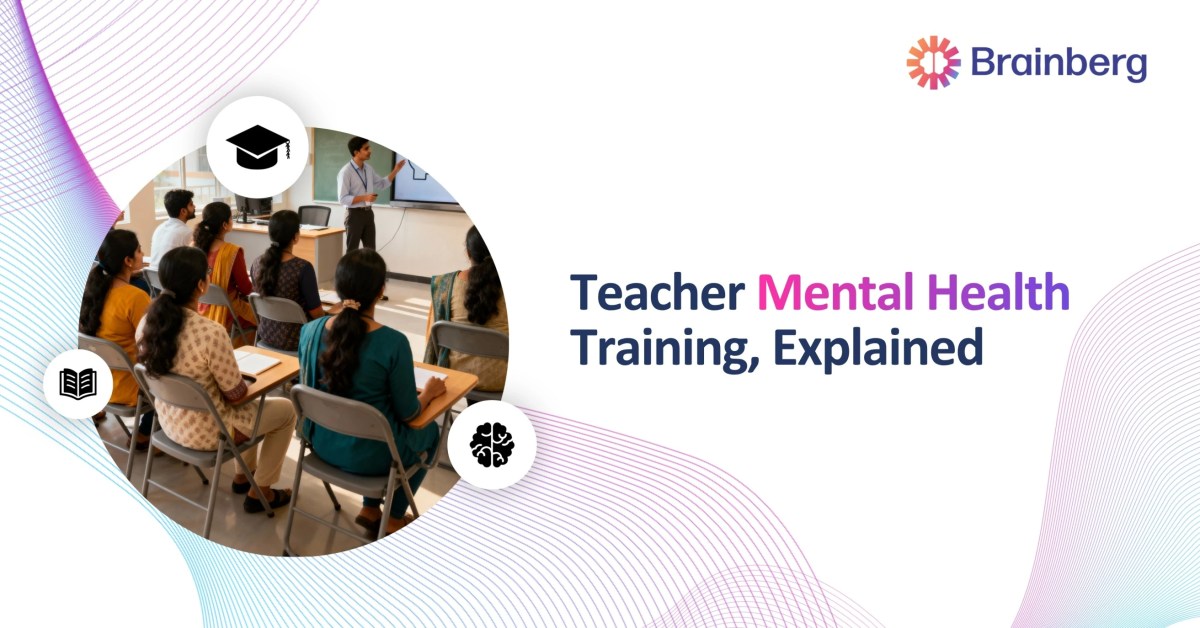
Teacher mental health training is the one line item most Indian schools still treat as optional, and that oversight is costing classrooms more than anyone likes to admit.
Walk into any staff room in September, and you’ll find teachers juggling lesson plans, parent calls, board deadlines, and a room full of children who each carry their own set of emotions and challenges. Somewhere in that juggling act, the teacher’s own wellbeing quietly slides off the list. Not because schools don’t care, but because nobody ever taught them how to catch it before it drops.
Teacher Mental Health Training: Why Do Teachers Need It?
Simply put, teacher mental health training exists because the job demands a kind of emotional labour that pedagogy courses were never built to prepare anyone for. A B.Ed. programme teaches you how to structure a lesson plan and manage a syllabus. It rarely teaches you how to sit with a student mid-anxiety attack, absorb a tense parent conversation, or notice your own stress climbing before it tips into exhaustion. Without that skill set, teachers end up handling emotionally loaded situations on instinct, and instinct alone is a tiring, unreliable teacher of its own.
This isn’t a small gap either. A 2023 UNESCO survey found that more than 60% of Indian teachers named non-teaching duties and administrative pressure as their biggest source of stress, with little structured outlet for that pressure. It just accumulates.
Teacher Mental Health Training: The Gap Nobody’s Talking About
The absence of teacher mental health training doesn’t stay invisible for long, and the data proves it. A cross-sectional study of Indian schoolteachers, published in the Journal of Mental Health and Human Behaviour, found that nearly six in ten teachers scored high enough on standard screening measures to warrant a closer look for anxiety or depression, with over a third reporting overlapping symptoms of both. Most had no personal history of seeking help and limited awareness of what mental health support could even look like for them.
Meanwhile, national policy has quietly acknowledged the problem from the other direction. NCERT’s own review of student wellbeing noted that while teachers are expected to support children’s social and emotional development, preparing teachers for their own wellbeing and emotional competence remains a low priority in most teacher training programmes. So the expectation exists. The preparation doesn’t. That’s the gap, in one sentence.
Why does this matter beyond the staff room? Because an emotionally exhausted teacher cannot reliably notice the quiet, anxious kid in the third row, or de-escalate a classroom conflict without it turning personal. Burnout doesn’t stay contained to one person. It leaks into lesson quality, patience, attendance, and eventually, retention.
Teacher Mental Health Training in Practice: What It Actually Looks Like
Teacher mental health training doesn’t need to be complicated to work, and this is where the jargon usually scares people off unnecessarily. Broken down, it covers three practical layers:
- Self-awareness tools – simple, evidence-based ways for teachers to track their own stress and energy levels before they spiral, rather than after.
- Classroom-facing skills – recognising early signs of distress in students (withdrawal, mood swings, sudden drops in participation) and knowing what to do next, without turning into an untrained counsellor.
- Systemic support literacy – understanding when and how to refer a student or colleague to a school counsellor, and knowing that asking for that referral isn’t a failure.
None of this requires teachers to become therapists. Good mental health training for teachers simply gives them a working vocabulary and a few dependable habits, the same way classroom management or assessment design training would. Psychoeducation, in plain terms, means teaching people how minds and emotions work so they respond with understanding instead of guesswork.
How Mental Health Training in Schools Changes the Classroom
Mental health training in schools tends to show up in small, unglamorous moments rather than dramatic breakthroughs. A teacher trained to spot early stress signals might pause a lesson two minutes earlier than usual, ask a genuinely open question, and catch a problem before it becomes a crisis. Multiply that across thirty classrooms, and you’re looking at a calmer building.
Before your next professional development calendar review, it’s worth running through a quick gut-check:
- Does our PD plan include anything beyond academic upskilling this year?
- Would our teachers know who to approach on campus if a student showed signs of distress?
- Have we ever asked teachers how they’re coping, not just how their students are?
- Is there a repeatable system in place, or did wellbeing show up once as a one-off workshop?
If more than one of those made you pause, that’s not a failure. That’s just where most schools currently stand.
Building Training for Teachers on Mental Health That Actually Sticks
The schools getting this right treat training for teachers on mental health as a system, not an event. That means recurring sessions instead of a single annual workshop, practical role-play instead of slide-heavy lectures, and psychometric tools that flag which teachers or classrooms need support before problems surface. It also means leadership modelling the behaviour it wants to see. A principal who openly takes a breather between back-to-back meetings sends a louder message than any poster in the staff room could.
Consistency, more than intensity, is what makes this kind of training stick.
Teacher mental health training isn’t a soft add-on to an already packed school calendar. It’s the structural piece that determines whether every other investment in a school, from curriculum to counselling, actually holds up under daily pressure. Schools that build it in deliberately tend to see it show up everywhere else: in calmer classrooms, steadier retention, and teachers who stay because they feel equipped, not just employed. At Brainberg, this is exactly the gap our teacher wellbeing programs under Mission Manomitra are built to close, with tools that help schools train, track, and support their teachers’ mental health as part of everyday practice, not a once-a-year checkbox.