

Teacher Mental Health Training: Why It’s the Missing Piece in Indian Schools
August 27, 2026
World Alzheimer’s Day: What Cognitive Decline Actually Looks Like
September 16, 2026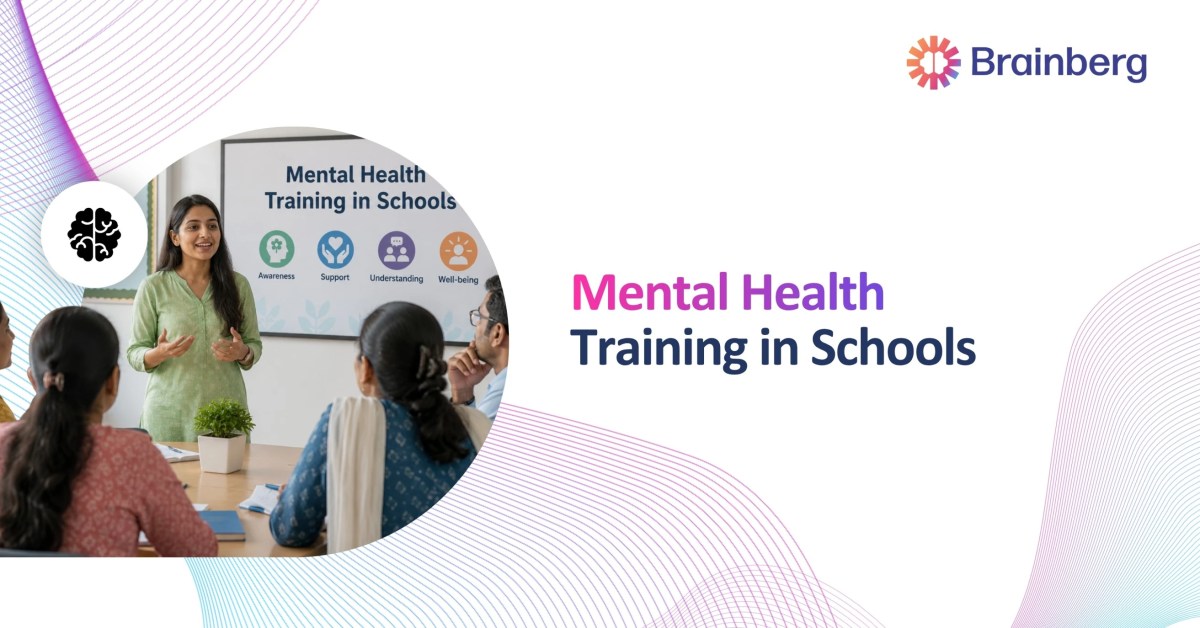
Mental health training in schools used to sound like something reserved for counsellors, a specialist add-on tucked away down the corridor. Not anymore. Walk into any staffroom today, and you’ll hear teachers swapping notes on anxious students, shrinking attention spans, and classrooms that feel harder to hold together than they did five years ago. Here’s what surprises most school leaders when they first look into this: it isn’t just a wellbeing conversation. It’s an academic one. When teachers are trained to recognise and respond to student mental health, something measurable happens to grades, participation, and classroom focus.
Mental Health Training in Schools: What It Actually Means
Mental health training in schools refers to structured, ongoing preparation that helps teachers and staff recognise early signs of emotional distress, respond appropriately, and know when to refer a student for more support before a small issue snowballs. It’s not a one-off assembly or a poster on a noticeboard, and it shouldn’t feel like one either. Good training builds a working vocabulary around student wellbeing. Terms like social-emotional learning (SEL, essentially teaching students to name and manage their own feelings), psychometric assessment (scientifically validated tools that measure traits like resilience, motivation, or stress tolerance), and trauma-informed practice (approaching a struggling student with curiosity instead of punishment) start showing up in everyday staffroom conversation. None of this asks a teacher to become a therapist. It just asks them to become a better first responder inside their own classroom.
Does Mental Health Training Improve Student Grades?
Short answer: yes. Peer-reviewed research points to a direct, positive link between teacher training in student mental health and stronger academic outcomes, including better engagement, fewer behavioural disruptions, and improved grades over time. One frequently cited finding is that schools with more mental-health-trained teachers showed measurably stronger academic progress compared to schools without that training. The logic isn’t complicated, really. A student who feels seen and supported has more mental bandwidth left for actual learning. Anxiety, unresolved stress, or an unaddressed emotional issue quietly eats into working memory, attention span, and motivation, the exact resources a child needs to perform well in class.
Quick self-check for school leaders: can your teachers name three early signs of student anxiety versus three signs of plain disengagement? Do they know who to loop in within the first hour of noticing a concern? If the honest answer is “not really,” that’s your starting point, not a failure.
Mental Health Training in Schools and the Research on Academic Outcomes
Mental health training in schools rarely works in isolation, though. It works best alongside a functioning school counselling system, where teachers spot the early signals and counsellors follow through with structured support. Research built around frameworks like CASEL’s social-emotional competencies has repeatedly shown that when these two layers work together, students report steadier classroom relationships, lower absenteeism, and more consistent performance across terms, not just in a single test cycle. One statistic is hard to ignore here: global estimates suggest that roughly one in five adolescents faces a diagnosable mental health condition in any given year, yet most teachers never receive formal preparation for spotting it. That gap, not the students themselves, is usually the real problem schools are solving for.
Mental Health Training in Schools: The Role of Emotional Intelligence and School Counselling
Good mental health training in schools eventually comes down to two things: emotional intelligence and counselling support. Emotional intelligence, or EQ, is simply a person’s ability to recognise, understand, and manage emotions, both their own and everyone else’s around them. In students, high EQ tends to show up as better focus, fewer meltdowns over tough assignments, and an easier time asking for help before falling behind. In teachers, it’s the difference between reacting to a disruptive student and actually understanding what sits underneath the behaviour. This is exactly where school counselling earns its keep in a school’s larger support system. A trained counsellor doesn’t just handle the crises; they help build the everyday emotional skills that keep an entire classroom functioning smoothly. So, ask yourself this: how many teachers on your staff currently feel confident enough to open a conversation with an anxious student, rather than sending them straight down the hall to the counsellor’s office? That one number says a lot about where your school‘s training gap actually sits.
Building a Mental Health Training Program: Emotional Intelligence, Counselling and Beyond
A single workshop won’t move the needle much. A genuine mental health training program needs a few non-negotiables:
- Ongoing, not one-off. Short refreshers spread across the year work better than one big seminar in August.
- Scenario-based practice. Role-playing real classroom situations lands harder than lecture slides ever will.
- A clear referral pathway. Teachers need to know exactly who to loop in, and when, so school counselling doesn’t turn into a bottleneck.
- Data, not guesswork. Psychometric tools that measure student wellbeing objectively, rather than relying on gut instinct alone.
- Visible leadership buy-in. Principals who prioritise this openly send a signal that emotional intelligence matters as much as exam scores do.
Get these five right, and training stops being a compliance checkbox. It starts changing what happens inside a classroom, day to day.
None of this needs to feel overwhelming for school leadership. Getting mental health training in schools right is less about hiring an army of specialists and more about equipping the people already in the room, your teachers, with the confidence to notice when a student needs support before performance quietly starts to dip. Start small: pick one term, one training module, one review cycle, and actually measure what shifts. If your school is rethinking how it approaches student wellbeing, counselling infrastructure, or classroom-level emotional intelligence, Brainberg works with schools on exactly this, building psychometrically grounded, practical training programs that connect student mental health to real academic outcomes. Worth a conversation before the next term begins.